
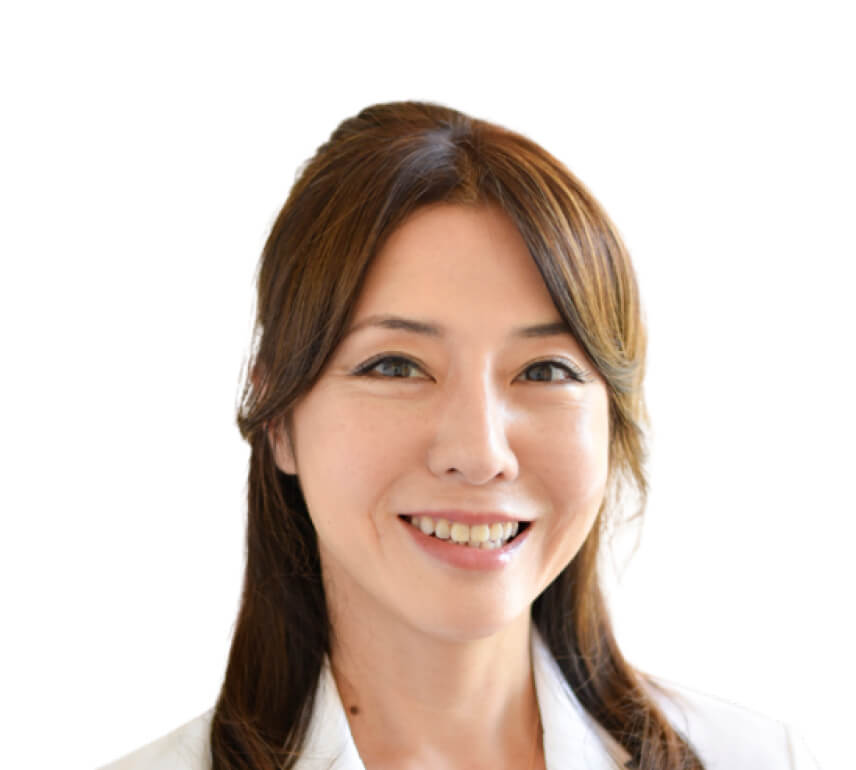
[Interview with Director Chiaki Kawashima] Expanding the possibilities of regenerative medicine with hormone and peptide therapies.
Director
Chiaki Kawashima
Dr. Kawashima graduated from Tokyo Medical University. She established Korokai Medical Corporation in 2002. As a medical institution approved by the Ministry of Health, Labour and Welfare,*1 the hospital provides regenerative medicine therapies and has treated numerous patients both in Japan and from overseas. In addition to domestic conferences, Dr. Kawashima actively participates in international conferences such as those of the American Academy of Dermatology, the American Society for Laser Medicine and Surgery, and the American Academy of Anti-Aging Medicine (A4M) and incorporates the latest treatment techniques into her practice. As a peptide therapy specialist certified by A4M, she employs a comprehensive treatment strategy that is not bound by conventional medical care and uses novel regenerative medicine applications in combination with hormone therapy or peptide therapy to treat various diseases.
She is a member of the Japanese Dermatological Association, the Japanese Society of Aesthetic Dermatology, the Japanese Society of Aesthetic Plastic Surgery, and the Japanese Society of Anti-Aging Medicine. She has also received various certifications including as a specialist in Dr. Obagi’s skincare products, as a peptide therapy specialist from A4M, as a hyaluronic acid filler injection instructor from Galderma, as a specialist of ThermaCoolTM treatments, as a specialist of DoubloTM treatments, and others.
*1 Source: Ministry of Health, Labour and Welfare https://saiseiiryo.mhlw.go.jp/published_plan/index/2
Regenerative medicine has been garnering attention in recent years for its potential to treat previously intractable diseases.
However, some people may not know how regenerative medicine is used in treatments.
In fact, regenerative medicine can potentially improve symptoms more effectively when combined with other treatments.
In this article, we interviewed Dr. Chiaki Kawashima, the Director of Korokai Medical Corporation Regenerative Medicine Division, who has always been at the forefront of medical care. We asked her about the benefits of regenerative medicine and the advantages of combining it with other treatment methods.
Please read further if you are someone “who wants to develop a good understanding of regenerative medicine before undergoing treatment involving such medicine.”
It all began when I became fascinated with the benefits of regenerative medicine, which are distinct from those of conventional treatments.
Please tell us why you decided to venture into the field of regenerative medicine.
It’s because regenerative medicine can give us a chance to treat refractory diseases.
Conventional treatments are still effective when used in an appropriate situation.
For example, restoration of collagen is also possible with laser treatments.
However, recent years have seen an increase in the number of patients with intractable diseases that are unlikely to be cured or difficult to treat in the first place; this calls for new therapeutic approaches.
What can potentially be a breakthrough in this situation is stem cell-based “regenerative medicine,” which is also offered by our hospital.
Regenerative medicine therapies using stem cells are strictly reviewed in terms of validity, safety, doctor allocation, and cell processing management by a Certified Special Committee for Regenerative Medicine approved by the Ministry of Health, Labour and Welfare.
Once these are found appropriate, the treatment plan can be submitted to the Ministry of Health, Labour and Welfare, and use of the regenerative medicine therapy in patients is permitted.
In this approach, adipose tissue-derived stem cells are obtained from patients; these are cultured and returned to the body via intravenous injection with the aim of promoting the regeneration and repair of tissues and organs in the body.
What you can expect from this treatment is not a temporary suppression of symptoms but regeneration of a problematic site, which is why it holds great promise for refractory diseases.
Specific conditions targeted by this approach include heart failure, Parkinson’s disease, hepatic dysfunction, diabetes mellitus, cerebral infarction, and osteoarthritis. I was so impressed by its therapeutic effects in these conditions that I started working on regenerative medicine applications.
There is another reason why I ventured into the field.
It is due to the problem of population aging, which many countries are likely to be facing.
As populations age further, more people naturally start to experience problems with their body functions, thus increasing the number of patients seeking treatment.
When that happens, the significance of regenerative medicine will increase even further.
“If I start offering regenerative medicine therapies now, it can save many patients in the future.”
With that thought, I began my journey into the field of regenerative medicine, which has brought me here today.
I would like my patients to have a sound understanding of regenerative medicine before truly experiencing its beneficial effects.
experiencing its beneficial effects.
It’s about giving a proper explanation so that our patients can gain accurate knowledge of regenerative medicine.
Some patients visiting our hospital have overly high expectations for regenerative medicine or the use of stem cells in regenerative medicine therapies.
There are more than a few people who think “stem cells are effective for any disease.”
It is true that regenerative medicine holds great potential for even repairing tissues that were previously irreparable.
However, regenerative medicine cannot provide a complete 100% cure for every disease.
In addition, because regenerative medicine is intended to cure a disease, it may not produce immediate effects like pain reduction as in conventional symptomatic therapy.
Providing regenerative medicine therapies without disclosing these facts would be nothing but an act of betrayal to our patients who place their trust in our hospital.
Therefore, we always provide pre-treatment counseling to patients to explain the details of the regenerative medicine therapy they will receive, including its actual effects, contents, and safety.
What moment do you find rewarding as a physician?
It is when I’m thanked by patients who are happy with the effects of the regenerative medicine therapy they received.
When providing treatment, I place the greatest importance on “whether the patient is actually feeling the beneficial effects.”
“I want to treat our patients more effectively to make them feel fully satisfied.”
This desire led me to combine stem cell-based regenerative medicine with hormone therapy or peptide therapy.
This “Patient First” concept has served as the basis for our treatment strategy.
In order to achieve the best possible treatment outcomes for our patients, we strictly select evidence-based therapies only.
Furthermore, the same physician who performed the procedure will continue to follow up with the patient so that any issues or concerns can be promptly communicated.
As a physician, I find it most rewarding when our patients are happy with the effects of the treatments they receive and the highest priority placed on them.
The optimal solution for making up for the disadvantages of regenerative medicine was hormone therapy or peptide therapy.
As I mentioned earlier, combining regenerative medicine with hormone therapy or peptide therapy is expected to supplement the therapeutic effects.
Although regenerative medicine offers potentially high therapeutic effects, it also has its disadvantages; patients need to undergo multiple treatment sessions before they can truly experience its effects.
Since the treatment cannot be completed in one session, the treatment period is prolonged, which will also increase the cost.
Regenerative medicine therapies are expensive because they are not covered by public health insurance. Therefore, the more treatment sessions a patient needs, the higher the financial burden on that patient.
“How can we reduce the number of treatment sessions using regenerative medicine?”
The solution was combining it with hormone therapy or peptide therapy.
Hormone and peptide therapies are expected to correct hormonal imbalances and improve physical and mental health.
They both help to regulate body functions; here, I found the potential to supplement regenerative medicine therapies. This led to the idea of combining them together.
Our mission for the future is to help more patients genuinely feel the beneficial effects of regenerative medicine.
Please tell us about the future prospects of regenerative medicine in Regenerative Medicine Division at Korokai Medical Corporation.
We would like to help improve our patients’ health and quality of life by making the most of the potential of regenerative medicine and actively applying it to a wide range of therapeutic areas.
To make more patients smile, we will continue devoting ourselves to regenerative medicine research.
Please give a message for patients who are considering visiting the hospital and their families.
It is our creed to propose treatments tailored to individual patients’ concerns.
In addition to regenerative medicine, we will also utilize hormone therapy or peptide therapy depending on the case and make utmost efforts to produce the best possible outcomes for each patient.
1) Treatment method
Stem cells present in your own adipose tissue are collected and cultured before being administered via intravenous drip or local injection to an affected area.
2) Risk for adverse reactions
During and after fat harvesting: Some people may experience internal bleeding, swelling, postprocedural infection, postprocedural scar appearance, or injection site pain.
During and after stem cell administration: Some people may experience injection site pain, allergic reaction, or pulmonary embolism.
3) Contact information
Regenerative Medicine Division, Korokai Medical Corporation
5th floor, Precious 18, 4-14-6 Minami-Azabu, Minato-ku, Tokyo
4) Cost
This treatment is considered as self-funded medical care not covered by health insurance.
Approximately 1,650,000 JPY including tax (may vary depending on diagnosis)
For more information, please contact us.
5) Procurement route
Stem cells are cultured at a CPC affiliated with our hospital.
6) Devices/drugs with the same efficacy that are approved in Japan
No drugs with the same efficacy have been approved in Japan.
7) Safety information from other countries
Safety reports from other countries are not available.
*There is a possibility that this treatment may present a significant unidentified risk.
8) Unapproved status
This treatment uses a drug that has not been approved under the Pharmaceuticals and Medical Devices Act.
9) Unapproved drugs/devices
Public relief systems (The Relief System for Sufferers from Adverse Drug Reactions and the Relief System for Sufferers from Diseases Infected from Biological Products) do not apply to unapproved drugs and devices.